Friday, July 15, 2022

Herschel Walker - Republican Candidate for the Senate

Herschel Walker - Republican Candidate for the Senate
He lied about owning a nonexistent company
He lied about even graduating from college
He lied about graduating in the top 1%
He lied about being HS valedictorian
He lied about being a policeman
He lied about being in the FBI
He lied about his secret kids
But now he has outdone himself and will even surpass Trump in stupidity and as a liar.
His comments on the climate/Green New Deal:
"Since we don't control the air our good air decided to float over to China's bad air so when China gets our good air, their bad air got to move. So it moves over to our good air space. Then now we got to clean that back up."
Comment
Share

 Geoengineering


I read an interesting article today of a way to decrease the amount

sunlight so as to decrease warming of the oceans.

Here is the title:

MIT Scientists Propose Space Bubbles to Reverse the Worst of Climate Change

By Angely Mercado

6/16/22 2:48PM


The idea is to create a really huge “raft” of silicone bubbles which if positioned between the earth and the sun would decrease the solar radiation. I copy the article below:

A team of researchers at the Massachusetts Institute of Technology believe that we can mitigate the worst of climate change with… space bubbles. They’ve outlined a strategy in which a huge raft of bubbles, carefully positioned between Earth and the Sun, would deflect sunlight (and thus heat) to stop further global warming.


“Geoengineering might be our final and only option. Yet, most geoengineering proposals are earth-bound, which poses tremendous risks to our living ecosystem,” a web page dedicated to the solution reads. “If we deflect 1.8% of incident solar radiation before it hits our planet, we could fully reverse today’s global warming. The bubble array would be made of inflatable shields of thin silicon or another suitable material, according to the team. The bubble cluster would be placed in outer space at a Lagrange Point, where the Sun’s and Earth’s gravitational pulls create a stable orbit. The researchers also said that if the plan becomes a reality in the future, the completed array would be roughly the size of Brazil.


They admitted that one of the main concerns with their proposal would be the logistics of fabricating a large film, transporting it into space, and then unfolding it to form the bubble raft. They suggested fabricating the spheres in outer space to minimize shipping costs.

“[The] bubbles can be intentionally destroyed by breaking their surface equilibrium, this would make the solar geoengineering solution fully reversible and significantly reduce space debris,” the MIT researchers wrote in a statement. They also pointed to the difficulties of maintaining the integrity of the bubble shield. “Effective replenishment rate will be studied to ensure the shield maintains its size, together with strategies to guarantee a smooth end-of-life transition.”

This isn’t the first space-based solution proposed to block the Sun in some way. In 2017, a study suggested an Earth-sized shield to stop solar flares from messing with our communication systems.


But why go to such extremes (which surely have unforeseen risks and consequences)? The MIT researchers described the proposed space bubbles as something to supplement other climate change mitigation efforts, but it is still a speculative plan, and other solutions currently exist. If the political will, funding, and technology is available for these high-tech solutions, the same should be possible for much more reasonable solutions, like putting a stop new oil and gas drilling projects.


According to the Intergovernmental Panel on Climate Change, we only have a a jarring three-year deadline to curb our emissions and stop climate disaster. Our current fossil fuel infrastructure is enough to push us over that edge, and we can prevent that by keeping the oil in the ground and working to decarbonize our systems.

People in the U.S. are already suffering the consequences of years of emissions. Some of the largest water reservoirs on the West Coast and in the Southwest are drying up. Several states are experiencing a dangerous heatwave right now, and cities all over the country are implementing water restrictions due to widespread drought. We don’t exactly have the time to tinker around in space, hope that it works, and then continue to pump greenhouse gases into the atmosphere.


I actually suggested a similar idea several years ago in my Blog (Larry Simpson’s Thoughts and Musings), based on an article by a graduate student.

 I copy my old Blog posting below.

“Dr. Lagrange Would Be Smiling


In the late 1700's, the mathematicians, Leonhard Euler and Joseph Lagrange, discovered that there are five points where the gravitational attractions of two astronomical bodies exactly cancel out. Actually, due to the elliptical orbit of the earth, these are "areas" rather than points. A diagram of the five Earth-Sun Lagrange sites is shown below (from Wikipedia).

These sites are not just of academic interest, but may actually be the saviors of the world! This is a rather presumptuous statement, even for a molecular biologist like myself, so let me try to explain. In 1958 the Polish astronomer, Kordylewski, observed the presence of large very faint clouds of dust at two of these Lagrange sites. And of course there have been many science fiction books using Lagrange sites for a variety of fantastic operations..


And now the plot thickens. A few months ago I read an article about a proposal by Russel Bewick, a graduate student, and his collaborators in a paper in the Journal of Space Sciences which is a respected journal. They propose to drag a fairly large asteroid such as Ganemede 1036 to the L1 Lagrange point, and to attach a “mass-driver” to generate huge clouds of dust. These would encompass around 1600 km and would be prevented from wandering off by the gravitational pull of the asteroid. Bewick calculated that this cloud could produce a 1.6% reduction in the sunlight reaching the earth, too little to be actually detected by eye. But enough to decrease the temperature of the earth by around 2 degrees C and eventually ameliorate the effects of global warming.


When I read this I said to myself that this is a great idea but not feasible. The technology does not yet exist and the possible dangers abound such as making an error (ie using English and not Metric units, as was actually done for a Mars lander some time ago!) and thereby letting the asteroid hit the earth and destroy 90% of the life as happened 60 million years ago in the Yucatan. But by the time we have this technology the accumulative effects of global climate change may be so horrible that this may be a chance worth taking to save our civilization! “


In fact NASA has actually proposed an asteroid capture project for developing a way to nudge the asteroid and eliminate the possibility of it hitting the earth. The same method could possibly be used to capture a large asteroid and move it to the L1 Lagrange point. Of course decreasing the heating of the ocean would not solve all the other problems of climate change, such as acidification of the oceans and melting the ice in the artic and Antarctic and causing droughts and flooding. But it may be a start.


Secret Service deletes text messages from Jan. 5 and 6


You have to admit that the first time you read that the Secret Service guarding Trump deleted multiple text messages sent on January 5th and 6th , you said to yourself “Secret Service - What the fuck?”


OK Here is my take on this:


We know that Trump almost strangled an agent who refused to drive him back to the capital which was in the throes of a pro-Trump riot at that time. We also know that Trump had put his loyalist agent, Tony Ornato, as Deputy Chief of Staff. And we know that Ornato told people that Hutchinson’s account of this episode “was not consistent with his understanding of the incident”. I assume this means that he thinks that Trump did not try to strangle the agent. Another fact we know is that V.P. Pence refused to enter the limo in the basement of the capital and be driven by the Secret Service agents to a military base, since he wanted to remain in the capital for the certifications of the true electors.


Now think about what would have happened if Pence had been driven to a military base at that time. The electors would not have been certified and Trump’s people may have hanged Pence since he had no “spine”. In any case, this was the Eastman and Giuliani scenario in which Pence did not certify the true electors leading to the states.


The Eastman Proposal


1. VP Pence, presiding over the joint session (or Senate Pro Tempore Grassley, if Pence recuses himself), begins to open and count the ballots, starting with Alabama (without conceding that the procedure, specified by the Electoral Count Act, of going through the States alphabetically is required).


2. When he gets to Arizona, he announces that he has multiple slates of electors, and so is going to defer decision on that until finishing the other States. This would be the first break with the procedure set out in the Act.


3. At the end, he announces that because of the ongoing disputes in the 7 States, there are no electors that can be deemed validly appointed in those States. That means the total number of “electors appointed” – the language of the 12th Amendment -- is 454. This reading of the 12th Amendment has also been advanced by Harvard Law Professor Laurence Tribe (here). A “majority of the electors appointed” would therefore be 228. There are at this point 232 votes for Trump, 222 votes for Biden. Pence then gavels President Trump as re-elected.


4. Howls, of course, from the Democrats, who now claim, contrary to Tribe’s prior position, that 270 is required. So Pence says, fine. Pursuant to the 12th Amendment, no candidate has achieved the necessary majority. That sends the matter to the House, where the “the votes shall be taken by states, the representation from each state having one vote.” Republicans currently control 26 of the state delegations, the bare majority needed to win that vote. President Trump is re-elected there as well.

5. One last piece. Assuming the Electoral Count Act process is followed and, upon getting the objections to the Arizona slates, the two houses break into their separate chambers, we should not allow the Electoral Count Act constraint on debate to control. That would mean that a prior legislature was determining the rules of the present one — a constitutional no-no (as Tribe has forcefully argued). So someone – Ted Cruz, Rand Paul, etc. – should demand normal rules (which includes the filibuster). That creates a stalemate that would give the state legislatures more time to weigh in to formally support the alternate slate of electors, if they had not already done so.

 6. The main thing here is that Pence should do this without asking for permission – either from a vote of the joint session or from the Court. Let the other side challenge his actions in court, where Tribe (who in 2001 conceded the President of the Senate might be in charge of counting the votes) and others who would press a lawsuit would have their past position -- that these are non-justiciable political questions – thrown back at them, to get the lawsuit dismissed. The fact is that the Constitution assigns this power to the Vice President as the ultimate arbiter. We should take all of our actions with that in mind.


This suggests that the Secret Service agents did not want Biden to become President and that Trump should! Voila - a coup has succeeded and democracy is dead.!

Sunday, May 1, 2022

Thoughts on Nuclear War

 Recently people are blithely discussing the high possibility of Putin finally realizing that Russia has lost the “war” with Ukraine, and decides to start a nuclear war with the West out of anger and spite. Then there are two possibilities – One is that one of his close friends allows him to “spend more with his family and the other is discussed in an essay that is copied below. I hope that Bob Anderson allows me to post this since it is that important for everyone to read.

Bob Anderson
Advocate for digital privacy for over 25 years

How many people would survive (globally) the first 30 days after a full on nuclear war/Armageddon?

Everything you read about nuclear war goes something like this…

It will be unimaginably horrible. Everyone will die, or want to. The End.

Well hang on, we can understand it better than that …

It will be the worst thing we’ve ever experienced, but the human picture will not turn completely black. So let’s talk about the aftermath, not only in the following days, but also in the months and years to come.

As you read this, please bear in mind that these are generalizations based on averages across a lot of research on the topic. This is not a scientific paper replete with references, it’s a generalized narrative … your dosage may vary.

Also, the initial part of this answer describes some pretty awful things, bad enough that you might want to stop reading. However, I urge you to press on, it does gradually get better.

First though, by “full on nuclear war / ArmageddonI take you to mean that everyone who has nuclear weapons uses them according to their worst-case strategic war planning. The USA and Russia attempt to wipe each other out, drawing in many NATO countries including the UK and France. Israel lights up the middle east, and Pakistan and India go all-out against one another. China goes after Japan and others, and North Korea attempts to incinerate South Korea, also lobbing a few at Japan just for good measure.

That’s a lot of bombs …

Just how many nuclear weapons are there?

Nine countries possess a total of approximately 14,655 nuclear weapons and the capacity to deliver many of them to their intended targets …

Country — total warheads (Wikipedia)

  • United States — 6,450

  • Russia — 6,850

  • United Kingdom — 215

  • France — 300

  • China — 280

  • India — 140

  • Pakistan — 150

  • North Korea — 20

  • Israel — 250 (estimated)

It’s important to understand that most nuclear powers will hold a significant fraction of their weapons in reserve for second and possibly third strikes, so even in an all-out attack not all weapons will be used. It’s also important to know that most countries have more weapons in inventory than they have the capacity to deliver to targets. Plus there will also be losses due to successful preemptive and counter-strikes, and several other reasons why the actual number of devices detonated will be less than the total number of devices available, perhaps on the order of 60% of the total, or about 8,800.

Sadly, that means even after the launch of an all-out attack, the threat of future nuclear annihilation will not disappear … perhaps as many as 4,000 unused weapons will remain under the tattered control of various governments and their military units. So even after an “all-out” nuclear war, the sobering fact is that the threat will not disappear. This will play a role in the years to come.

A world turned upside down …

When you look at the list of nuclear powers a striking fact jumps right out: The vast majority of the weaponized states and their targets are located in the northern hemisphere. That has profound implications, as we’ll soon see …

In the northern hemisphere, within 30 days the casualty rates in places like the USA, Western Europe, India, Pakistan, China and Japan could approach 40% from direct blast effects, thousands of massive fires, and the immediate social chaos.

However, in the southern hemisphere the casualty rates will be much lower, perhaps about 5% in the first 30 days, primarily from the erosion of social control systems as everyone scrambles to prepare and protect themselves.

That asymmetry — the fact that the northern hemisphere has been devastated while leaving most of the southern hemisphere nearly untouched by blasts and fires — will rapidly lead to massive waves of immigration coming from the north as survivors by the millions attempt to flee the initial horrors.

It won’t save them …

Remember, just as it’s illegal for central and south Americans to enter the USA without permission, the same is true in reverse. A wall on our southern border would quickly become a prison as Mexico orders its army, police forces and thousands of ordinary citizens immediately to kill anyone attempting to breach it to enter Mexico illegally. All pretense of fairness or international law would disappear within hours.

Much the same would be true in the surviving parts of South-East Asia, Indonesia, much of Africa, and places like New Zealand or New Guinea. They would all defend their borders and themselves with deadly force. It will be shoot-on-sight regardless of circumstance or age - old people, kids, it wouldn’t matter.

30 days later …

After 30 days the global casualty rate will be on the order of about 20% of humanity, or roughly 1.5 billion people, mostly in the northern hemisphere.

About half of them, 750 million worldwide, will die in the first few hours of the direct effects. The other half, another 750 million, will die from sickness and violence in the following few weeks. For example, in all of the major target countries — places like the USA, India, Italy or France, to name just a few — there will be no doctors, no electricity, no police. There will be no law.

All the norms of society will disappear literally in a flash. Snowflakes will melt instantly, it will be purely survival of the vicious. And as bad as that is, it’s during the next few months that things truly turn to shit …

The following months … Nuclear Winter

The nuclear blasts will be unspeakably horrible, but many people will survive the initial onslaught. Instead, it’s the fires and smoke that will eventually kill far more people through starvation and disease than all the nuclear detonations combined.

Depending on yield, a single nuclear weapon detonated as an airburst (most would be) will have a blast radius of 1–3 miles. Nothing within that survives. The energy is so great and moves so fast that you wouldn’t even feel it, you’ll be incinerated faster than your nerves can signal your brain, leaving nothing but your shadow against the concrete.

It’s at the circumference of each blast that things get truly horrible … fires will ignite instantly in a full circle around each blast over land. Anything combustible will ignite — buildings by the thousands, trees, cars, gas tanks, everything that can burn. And that’s just from one blast. Major metropolitan areas will be sprinkled with detonations intentionally targeted so that the fires they ignite merge into huge firestorms, by design.

Imagine everything from San Diego to Los Angeles all on fire at once, stretching inland for 50 miles. Everything from Bangor Maine south to Virginia burning. Much of southern England on fire. A third of Japan. Half of India. Much of western Europe. Even places like Auckland, New Zealand will be targeted just to deny military refuge. You get the picture.

These fires will kill at least as many people as the initial blasts, and there will be no one to put them out. They will burn for weeks until they run out of fuel at natural boundaries like rivers or are finally extinguished by weather.

World-wide the fires will inject enough smoke and ash into the atmosphere to turn noon to twilight in the middle latitudes of the northern hemisphere. No one knows how fast the atmosphere will cleanse itself — estimates range from months to several years — but what we do know is that it will cause the collapse of the food chains we survive on, for years.

The northern oceans will likewise be devastated by the lack of sunlight, which will kill off most of the plankton at the base of the marine food chain.

What about the southern hemisphere?

There’s an atmospheric region circling the globe called the tropical convergence zone which acts as something of a barrier between the northern and southern hemispheres. Overall it will prevent very roughly half of the smoke and particulate matter from homogenizing south of the equator.

That will still be awful, but whereas in the north sunlight after 2 months may drop to 20% of normal, in the southern hemisphere it may be quite a bit better, and by the time you reach the southern temperate zones, it may be only a 40 or 50% reduction, not 80%. Bad, yes, very bad, but with care some agriculture will still be possible, albeit at seriously reduced yields.

Fisheries will likewise be less impacted, especially in the southern-most oceans — they will still be able to produce a significant amount of food. Nothing close to normal, maybe only 25% of previous harvests. Badly injured, but not dead.

Millions in the southern hemisphere will still die, but hundreds of millions will be able to squeeze by and survive.

How about radiation?

Few people assess the implications and effects of radiation accurately. That’s understandable — it’s a complex topic that has been so oversimplified by mass media that when you say the word radiation, people’s minds jump instantly to mutant cockroaches the size of alligators, or flesh-eating creatures emerging from glowing green swamps.

The radioactive aftermath of a large nuclear war will be a very serious problem, especially in the general areas of detonations and for miles downwind. For most of the planet the background levels will increase a hundredfold, cancer rates and birth defects will skyrocket, and life expectancy will drop significantly. But unless you were near enough to one of the explosions to receive a high dose, it won’t kill you. At least not right away.

For example, from 1945 to 1963 the United States detonated hundreds of nuclear weapons in the deserts of the southwest (Wikipedia), many close enough to Las Vegas that the tops of the mushroom clouds were visible from the strip. Altogether, worldwide there have been two thousand tests. (Side note: There’s a morbidly fascinating YouTube video showing every nuclear bomb test on a map over time, it runs for 14 minutes. Search YouTube for video “LLCF7vPanrY”.)

Yes, you read that correctly, we’ve already detonated a couple thousand nukes, about a third of them as atmospheric explosions. The difference is it was done over (or under) sand or water where nothing can burn.

Of much greater concern will be whatever remains of the world’s 100+ nuclear power plants … it’s likely that they will be targets themselves, further increasing the total background radiation and definitely poisoning hundreds of square miles downwind of each. Even the ones that remain intact will shut down, and then be subject to gradual leaks of radiation for a long time as their containment buildings degrade and neutron flux weakens the primary reactor housings.

Even worse, almost all spent fuel for each reactor in most countries has been stored on-site awaiting a more permanent solution. These are still radioactive, and are kept in spent fuel storage ponds, safe within deep swimming-pool-like structures filled with water. With no one around to maintain them, the protective water will evaporate and they too will slowly begin to leak radiation.

The cumulative effect from the bombs and leaking reactors will increase the overall average radiation most survivors are exposed to by a factor of 100, or more in many cases. Some isotopes decay very fast, others are very long-lasting. The net effect will be greatly increased cancer rates over the years and decades to come, and a significant reduction in life expectancy, say by an average of 10 - 15 years.

What about survivalists (the ‘preppers’), how will they make out?

A few of the very best-prepared will do okay, maybe about one percent, but most will be as screwed as the rest of humanity, it will just take a little longer.

The thing about most ‘preppers’ is, they tend to emphasize preparedness in the areas of their personal fascinations in life, while simultaneously neglecting things that don’t interest them.

I actually met a family of survivalists last year, and it was a fascinating study in tunnel vision …

The head of the family is a weapons expert and a proud gun owner. After I was sworn to secrecy, he and his two grown sons showed me their ‘bug out’ facility. Chests puffed, they proudly displayed a frightening collection of firearms and ammunition, and explained in great detail how they had trained the entire family, kids included, how to shoot anything approaching their facility, aiming withering fire from various exposed portals of their mostly underground deep-woods hideout.

But when I asked about respirators against the smoke, and emergency oxygen tanks as the massive fire swept through the forest, all I got was blank stares.

Likewise when they proudly showed me their 2,500 gallon water tank … I asked if they had drilled a well, and how they planned to extract and filter water once the tank ran dry. Nothing. The same when I asked if they had a Geiger counter, or medical reference textbooks. Nada. And the same when I asked if they knew how to set a broken leg, or which antibiotic to use for a toothache, or a lung infection.

Finally, when I asked just how long they thought their little group of 5 adults and 7 kids would have the stamina to hold out against hundreds of survivors from ‘the big city’, who would also be armed to the teeth, amidst nervous looks they again assured me of the effectiveness of their arsenal.

And just to vent some of that building testosterone, they blasted off a couple of hundred rounds in a frustrated ejaculation by gunpowder. (Side note: let me make it clear that although I’m no expert, I’m conversant, comfortable and capable with firearms, when properly regulated they do have a place in civil society.)

The reality is that most survivalists use preparedness as a justification to pursue personal obsessions in magnified ways. In those specific areas they are well-prepared, but in vital but boring things they are as ill-equipped as any of us.

Case in point — in areas requiring advanced skills, such as medicine, energy or agriculture, they simply ignore all the problems they can’t answer, as if no one will get sick or shot, machines miraculously run forever and crops practically grow themselves.

That said, true survivalists know better. These are people who have prepared comprehensively and deeply across the entire spectrum of needs; people who realize that a dozen members is not enough, and have created much larger groups with diverse skills. Unless a nuke drops within 10 miles, they actually do stand a pretty good chance of emerging a few years later.

And make no mistake, it will take several years for the sky to clear enough for agriculture to resume without special assistance.

Recovery …

How many will make it past the first few years is anyone’s guess, but here are some very round numbers expressed as 5-year survivor percentages:

North America: 8%

Central America: 44%

South America: 55%

Western Europe: 12%

Eastern Europe (including Russia): 6%

Middle East: 19%

Africa: 42%

China: 27%

India: 22%

Southeast Asia: 40%

Australia / Oceania: 45%

Note that these are extremely approximate ‘guesstimates’. Numerous factors could make the survival rates higher or much lower, including time of year, how many warheads actually detonate, variations in targeting philosophies (military, civilian, both), human resiliency, national and personal preparedness, weather conditions and a lot else.

For example, for North America the 5-year survival might be as high as 10% or 12%, or as low as 1% or 2%. The numbers above are to provide a sense of magnitude. They are nothing more than my best guesses, taking into account current levels of industrialization, social systems and a lot of other factors.

Disease alone will become a major killer, as will contaminated water. With countless millions of unburied bodies — people, cows, cats, you name it — a laundry list of deadly bacteria will make a massive comeback. That bacterial blossom alone will kill a few hundred million before eventually extinguishing itself after a couple years (because the bodies decay to the point that they are no longer a bacterial food source).

The bottom line …

Somewhere between 50% and 80% of humanity will die, and the bulk of the world’s surviving population will inhabit the southern hemisphere 5 years later. This will be beyond horrible, but it will not be anywhere close to an extinction.

So what then?

Very gradually the remaining vestiges of governments and their shredded military will begin to restore a crude sort of order. The first bits of civil organization and recovery will occur within a year, but there won’t be the resources to do much … governments in most northern-hemisphere countries will be forced by cynical pragmatism to wait until the number of survivors drops to something they can manage.

Human ingenuity will counter some of these problems. For example even if sunlight is only 50% of normal after 6 months, the clever use of mirrors to illuminate greenhouses will help small but significant bands of people to survive.

Everything will be under martial law for many years to come. It will take a generation or two before people see any kind of municipal restoration, even things as basic as running water or electricity, let alone hospitals.

But recovery will come. Agriculture will return, science will not forget how to make antibiotics, very little knowledge will be lost. The nuclear power plants will be entombed. Children will be born, educated, and new engineers and doctors will graduate. Manufacturing will return. Eventually we’ll even see the internet reborn, and yes, it will have cat videos. Gradually over the next 50 to 75 years the world will mostly recover.

Unfortunately, it will continue to live under the threat of further nuclear exchanges. Maybe, just maybe, then at last we can all agree to get rid of the damn things, once and forever.

And finally …

No doubt this answer will trigger criticisms, questions and comments, mostly about people’s specific circumstances. Let me anticipate some of them …

Yes, it’s possible you will be in an area that suffers no direct blast effects and does not burn. Yes, it’s possible you’ll be able to scavenge successfully for enough years to survive. And yes, it’s possible you’ll be able to defend yourself against the starving hoards.

For all I know, you could survive 8 years on a thousand cases of Campbell’s soup jam-packed in a tornado shelter.

Humans are astonishingly resourceful, some will make it through even the most difficult circumstances. But in the northern hemisphere most will not.

And that’s just the point … any of these exceptions are possible, but none are likely. This narrative is about averages and aggregate effects, not about specific circumstances. I welcome your comments.


Bob Anderson

Sunday, December 12, 2021

A Modest Suggestion


I am going to say something I never thought I would say. It seems like the entire Republican Party has been taken over by the Trump crazies and the  insurrectionists. Correction: There are a few rational people left – e.g. Lynn Cheny, Adam Kinzinger, Mit Romney, Richard Burr. Party membership however now requires the candidate to say that they believe in the “Big Lie” of Trump which claims that Trump won the election due to the election being “rigged” although  this was negated by multiple recounts and court decisions which showed no evidence for any election problems. Biden clearly won this election in terms of overwhelming popular votes and electoral votes. Trump appears to feel that Goebbels was right in that if a big lie is repeated over and over again, people actually begin to believe it as true. In addition, the Republican Party currently in multiple states where they have the majority, are setting the stage for  electoral takeovers by both Gerrymandering districts to eliminate voting by minorities and democrats, and by removing anti-Trump people in the election section and replacing them with Trump loyalists who would be willing to actually change the votes if Trump still loses the election. The Trump “base” has intelligent educated people who know that the election was fair and that Biden won, but they are still willing to perform this incredible undemocratic action.

The Trump “base” have some additional behaviors that may be due to the “big lie” requirement. Many believe that various conspiracy theories are true, theories that every sane person would say are crazy. For example the QAnon adherents believe that Hillary and Bill Clinton ran a pedophile ring out of a specific Washington pizza restaurant in which thousands of Satan-worshipping pedophiles tortured and murdered  children and harvested a chemical from their blood, and that Trump will arrest 100,000 people from the highest levels of power who will face the “storm”, a day of reckoning.  

Many National intelligence people believe in   fact that the entire Republican Party is a national security risk. Indeed, Trump’s favorite leaders were Putin of Russia, Xi of China and Erdogan of Turkey. Trump also has insulted almost every previous ally and said that the US should leave NATO. Trump in fact once gave top secret information to the Russian foreign minister and ambassador at a meeting in the oval office. Trump was also able to insert his loyalists in top Pentagon and intelligence positions and to totally corrupt the Department of Justice by appointing his friend, Bill Barr, as Attorney General.  

How would one accomplish destroying the entire Republican Party? The normal way would be elections which would entirely remove Trump’s people from government by the ballot box.  However, given the recent actions of the Republicans to destroy the electoral process in this country, that is unlikely to succeed. A better way would be to utilize the American judicial system to arrest Trump and his cronies for criminal behavior, and prevent them from ever running for office again. This must however  be accomplished before the oncoming midterm elections which may be too late in view of the rapidity that Republicans are destroying the judicial system and perhaps democracy itself.

I   myself am very pessimistic, especially in view of the coming catastrophes that will occur worldwide if all countries do not cut use of fossil fuels by 50% by 2030. In fact, failure to do this, which appears to be almost certain, would cause a greater than 1.5 degree rise of temperature and even possibly a 2.5 degree temperature rise, which would be almost be an extinction event.  I hope I am wrong.

Tuesday, December 7, 2021

Trump and his International Relations


Copied from CNN

See https://tinyurl.com/23ja4k83

From pandering to Putin to abusing allies and ignoring his own advisers, Trump's phone calls alarm US officials

(CNN)In hundreds of highly classified phone calls with foreign heads of state, President Donald Trump was so consistently unprepared for discussion of serious issues, so often outplayed in his conversations with powerful leaders like Russian President Vladimir Putin and Turkish President Recep Erdogan, and so abusive to leaders of America's principal allies, that the calls helped convince some senior US officials -- including his former secretaries of state and defense, two national security advisers and his longest-serving chief of staff -- that the President himself posed a danger to the national security of the United States, according to White House and intelligence officials intimately familiar with the contents of the conversations.

The calls caused former top Trump deputies -- including national security advisers H.R. McMaster and John Bolton, Defense Secretary James Mattis, Secretary of State Rex Tillerson, and White House chief of staff John Kelly, as well as intelligence officials -- to conclude that the President was often "delusional," as two sources put it, in his dealings with foreign leaders. The sources said there was little evidence that the President became more skillful or competent in his telephone conversations with most heads of state over time. Rather, he continued to believe that he could either charm, jawbone or bully almost any foreign leader into capitulating to his will, and often pursued goals more attuned to his own agenda than what many of his senior advisers considered the national interest.
These officials' concerns about the calls, and particularly Trump's deference to Putin, take on new resonance with reports the President may have learned in March that Russia had offered the Taliban bounties to kill US troops in Afghanistan -- and yet took no action. CNN's sources said there were calls between Putin and Trump about Trump's desire to end the American military presence in Afghanistan but they mentioned no discussion of the supposed Taliban bounties.
    By far the greatest number of Trump's telephone discussions with an individual head of state were with Erdogan, who sometimes phoned the White House at least twice a week and was put through directly to the President on standing orders from Trump, according to the sources. Meanwhile, the President regularly bullied and demeaned the leaders of America's principal allies, especially two women: telling Prime Minister Theresa May of the United Kingdom she was weak and lacked courage; and telling German Chancellor Angela Merkel that she was "stupid."
      Trump incessantly boasted to his fellow heads of state, including Saudi Arabia's autocratic royal heir Mohammed bin Salman and North Korean dictator Kim Jong Un, about his own wealth, genius, "great" accomplishments as President, and the "idiocy" of his Oval Office predecessors, according to the sources.
        In his conversations with both Putin and Erdogan, Trump took special delight in trashing former Presidents George W. Bush and Barack Obama and suggested that dealing directly with him -- Trump -- would be far more fruitful than during previous administrations. "They didn't know BS," he said of Bush and Obama -- one of several derisive tropes the sources said he favored when discussing his predecessors with the Turkish and Russian leaders.
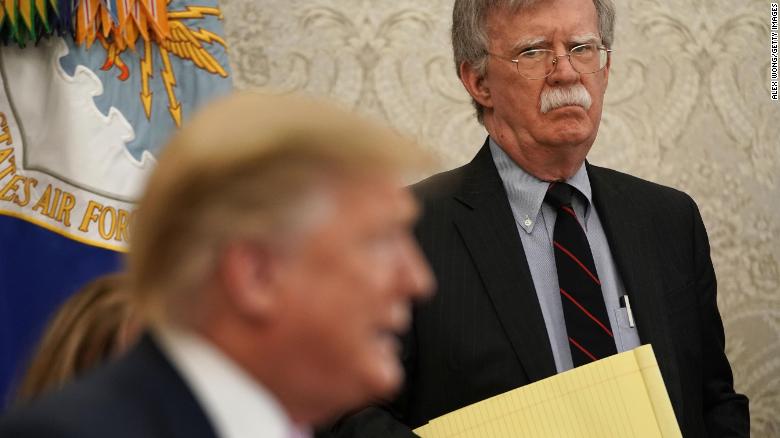
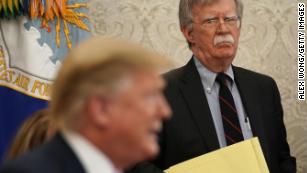
        Then-national security adviser John Bolton listens to President Donald Trump during a meeting with Egyptian President Abdel-Fattah el-Sisi in April 2019.
        The full, detailed picture drawn by CNN's sources of Trump's phone calls with foreign leaders is consistent with the basic tenor and some substantive elements of a limited number of calls described by former national security adviser John Bolton in his book, "The Room Where It Happened." But the calls described to CNN cover a far longer period than Bolton's tenure, are much more comprehensive — and seemingly more damning -- in their sweep.
          Like Bolton, CNN's sources said that the President seemed to continually conflate his own personal interests -- especially for purposes of re-election and revenge against perceived critics and political enemies -- with the national interest.
          To protect the anonymity of those describing the calls for this report, CNN will not reveal their job titles nor quote them at length directly. More than a dozen officials either listened to the President's phone calls in real time or were provided detailed summaries and rough-text recording printouts of the calls soon after their completion, CNN's sources said. The sources were interviewed by CNN repeatedly over a four-month period extending into June.
          The sources did cite some instances in which they said Trump acted responsibly and in the national interest during telephone discussions with some foreign leaders. CNN reached out to Kelly, McMaster and Tillerson for comment and received no response as of Monday afternoon. Mattis did not comment.
          The White House did not respond to a request for comment before this story published. After publication, White House deputy press secretary Sarah Matthews said, "President Trump is a world class negotiator who has consistently furthered America's interests on the world stage. From negotiating the phase one China deal and the USMCA to NATO allies contributing more and defeating ISIS, President Trump has shown his ability to advance America's strategic interests."
          One person familiar with almost all the conversations with the leaders of Russia, Turkey, Canada, Australia and western Europe described the calls cumulatively as 'abominations' so grievous to US national security interests that if members of Congress heard from witnesses to the actual conversations or read the texts and contemporaneous notes, even many senior Republican members would no longer be able to retain confidence in the President.

          Attacking key ally leaders -- especially women

          The insidious effect of the conversations comes from Trump's tone, his raging outbursts at allies while fawning over authoritarian strongmen, his ignorance of history and lack of preparation as much as it does from the troubling substance, according to the sources. While in office, then- Director of National Intelligence Dan Coats expressed worry to subordinates that Trump's telephone discussions were undermining the coherent conduct of foreign relations and American objectives around the globe, one of CNN's sources said. And in recent weeks, former chief of staff Kelly has mentioned the damaging impact of the President's calls on US national security to several individuals in private.
          Two sources compared many of the President's conversations with foreign leaders to Trump's recent press "briefings" on the coronavirus pandemic: free form, fact-deficient stream-of-consciousness ramblings, full of fantasy and off-the-wall pronouncements based on his intuitions, guesswork, the opinions of Fox News TV hosts and social media misinformation.
          In addition to Merkel and May, the sources said, Trump regularly bullied and disparaged other leaders of the western alliance during his phone conversations -- including French President Emmanuel Macron, Canadian Prime Minister Justin Trudeau, and Australian Prime Minister Scott Morrison -- in the same hostile and aggressive way he discussed the coronavirus with some of America's governors.
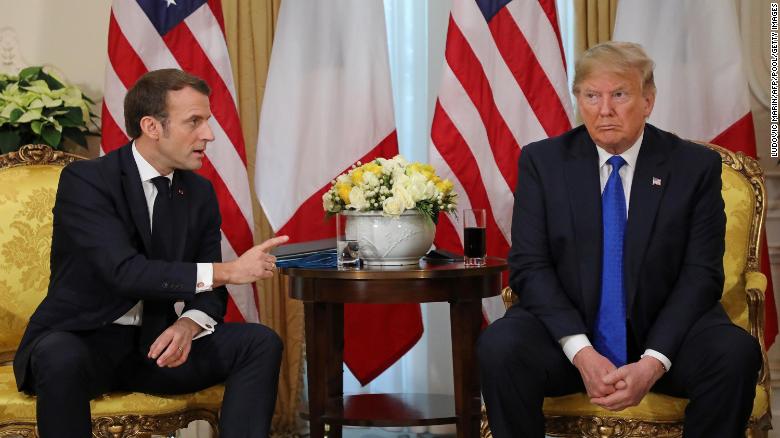
          President Donald Trump and French President Emmanuel Macron at a meeting in London in December 2019.
          Next to Erdogan, no foreign leader initiated more calls with Trump than Macron, the sources said, with the French President often trying to convince Trump to change course on environmental and security policy matters -- including climate change and US withdrawal from the Iranian multilateral nuclear accord.
          Macron usually got "nowhere" on substantive matters, while Trump became irritated at the French President's stream of requests and subjected him to self-serving harangues and lectures that were described by one source as personalized verbal "whippings," especially about France and other countries not meeting NATO spending targets, their liberal immigration policies or their trade imbalances with the US.
          But his most vicious attacks, said the sources, were aimed at women heads of state. In conversations with both May and Merkel, the President demeaned and denigrated them in diatribes described as "near-sadistic" by one of the sources and confirmed by others. "Some of the things he said to Angela Merkel are just unbelievable: he called her 'stupid,' and accused her of being in the pocket of the Russians ... He's toughest [in the phone calls] with those he looks at as weaklings and weakest with the ones he ought to be tough with."
          The calls "are so unusual," confirmed a German official, that special measures were taken in Berlin to ensure that their contents remained secret. The official described Trump's behavior with Merkel in the calls as "very aggressive" and said that the circle of German officials involved in monitoring Merkel's calls with Trump has shrunk: "It's just a small circle of people who are involved and the reason, the main reason, is that they are indeed problematic."
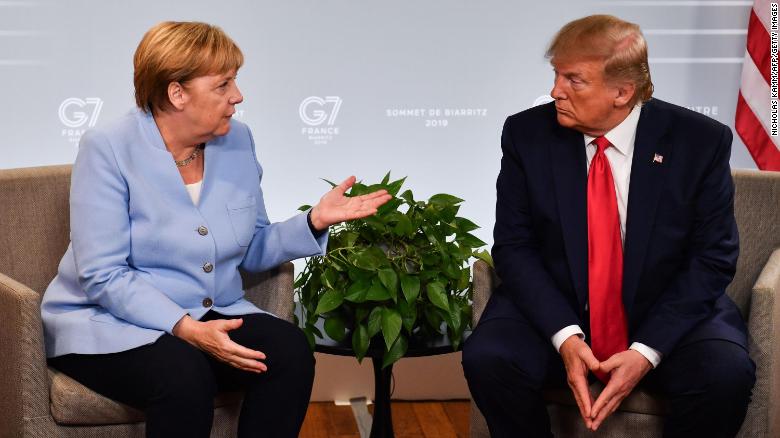
          German Chancellor Angela Merkel and President Donald Trump speak during the G-7 summit in Biarritz, France, in August 2019.
          Trump's conversations with May, the UK Prime Minister from 2016 to 2019, were described as "humiliating and bullying," with Trump attacking her as "a fool" and spineless in her approach to Brexit, NATO and immigration matters.
          "He'd get agitated about something with Theresa May, then he'd get nasty with her on the phone call," One source said. "It's the same interaction in every setting -- coronavirus or Brexit -- with just no filter applied."
          Merkel remained calm and outwardly unruffled in the face of Trump's attacks —"like water off a duck's back," in the words of one source -- and she regularly countered his bluster with recitations of fact. The German official quoted above said that during Merkel's visit to the White House two years ago, Trump displayed "very questionable behavior" that "was quite aggressive ... [T]he Chancellor indeed stayed calm, and that's what she does on the phone."
          Prime Minister May, in contrast, became "flustered and nervous" in her conversations with the President. "He clearly intimidated her and meant to," said one of CNN's sources. In response to a request for comment about Trump's behavior in calls with May, the UK's Downing Street referred CNN to its website. The site lists brief descriptions of the content of some calls and avoids any mention of tone or tension. The French embassy in Washington declined to comment, while the Russian and Turkish embassies did not respond to requests for comment.

          Concerns over calls with Putin and Erdogan

          The calls with Putin and Erdogan were particularly egregious in terms of Trump almost never being prepared substantively and thus leaving him susceptible to being taken advantage of in various ways, according to the sources -- in part because those conversations (as with most heads of state), were almost certainly recorded by the security services and other agencies of their countries.
          In his phone exchanges with Putin, the sources reported, the President talked mostly about himself, frequently in over-the-top, self-aggrandizing terms: touting his "unprecedented" success in building the US economy; asserting in derisive language how much smarter and "stronger" he is than "the imbeciles" and "weaklings" who came before him in the presidency (especially Obama); reveling in his experience running the Miss Universe Pageant in Moscow, and obsequiously courting Putin's admiration and approval. Putin "just outplays" him, said a high-level administration official -- comparing the Russian leader to a chess grandmaster and Trump to an occasional player of checkers. While Putin "destabilizes the West," said this source, the President of the United States "sits there and thinks he can build himself up enough as a businessman and tough guy that Putin will respect him." (At times, the Putin-Trump conversations sounded like "two guys in a steam bath," a source added.)
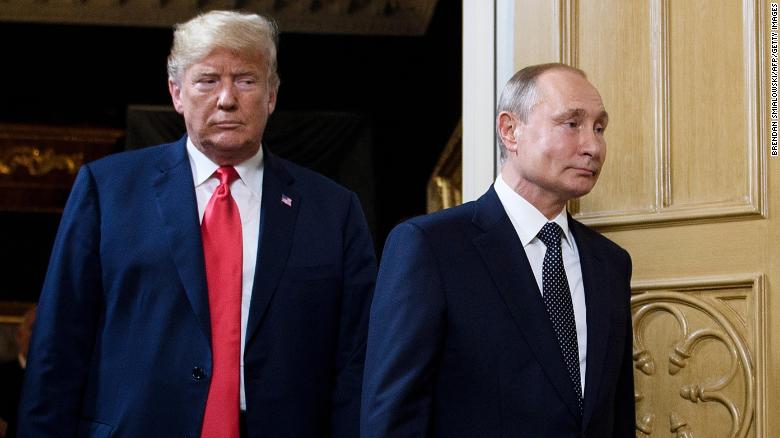
          President Donald Trump and Russian President Vladimir Putin arrive for a meeting in Helsinki in July 2018.
          In numerous calls with Putin that were described to CNN, Trump left top national security aides and his chiefs of staff flabbergasted, less because of specific concessions he made than because of his manner -- inordinately solicitous of Putin's admiration and seemingly seeking his approval -- while usually ignoring substantive policy expertise and important matters on the standing bilateral agenda, including human rights; and an arms control agreement, which never got dealt with in a way that advanced shared Russian and American goals that both Putin and Trump professed to favor, CNN's sources said.
          Throughout his presidency, Trump has touted the theme of "America First" as his north star in foreign policy, advancing the view that America's allies and adversaries have taken economic advantage of US goodwill in trade. And that America's closest allies need to increase their share of collective defense spending. He frequently justifies his seeming deference to Putin by arguing that Russia is a major world player and that it is in the United States' interest to have a constructive and friendly relationship -- requiring a reset with Moscow through his personal dialogue with Putin.
          In separate interviews, two high-level administration officials familiar with most of the Trump-Putin calls said the President naively elevated Russia -- a second-rate totalitarian state with less than 4% of the world's GDP -- and its authoritarian leader almost to parity with the United States and its President by undermining the tougher, more realistic view of Russia expressed by the US Congress, American intelligence agencies and the long-standing post-war policy consensus of the US and its European allies. "He [Trump] gives away the advantage that was hard won in the Cold War," said one of the officials -- in part by "giving Putin and Russia a legitimacy they never had," the official said. "He's given Russia a lifeline -- because there is no doubt that they're a declining power ... He's playing with something he doesn't understand and he's giving them power that they would use [aggressively]."
          Both officials cited Trump's decision to pull US troops out of Syria -- a move that benefited Turkey as well as Russia -- as perhaps the most grievous example. "He gave away the store," one of them said.
          The frequency of the calls with Erdogan -- in which the Turkish president continually pressed Trump for policy concessions and other favors -- was especially worrisome to McMaster, Bolton and Kelly, the more so because of the ease with which Erdogan bypassed normal National Security Council protocols and procedures to reach the President, said two of the sources.
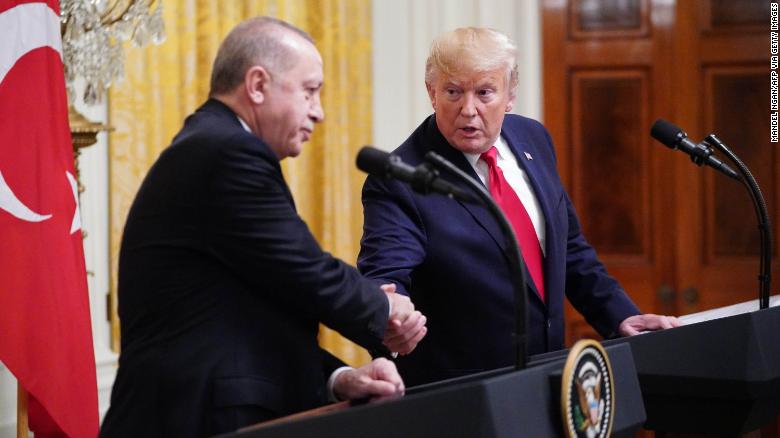
          President Donald Trump and Turkish President Recep Tayyip Erdogan take part in a White House press conference in November 2019.
          Erdogan became so adept at knowing when to reach the President directly that some White House aides became convinced that Turkey's security services in Washington were using Trump's schedule and whereabouts to provide Erdogan with information about when the President would be available for a call.
          On some occasions Erdogan reached him on the golf course and Trump would delay play while the two spoke at length.
          Two sources described the President as woefully uninformed about the history of the Syrian conflict and the Middle East generally, and said he was often caught off guard, and lacked sufficient knowledge to engage on equal terms in nuanced policy discussion with Erdogan. "Erdogan took him to the cleaners," said one of the sources.
          The sources said that deleterious US policy decisions on Syria -- including the President's directive to pull US forces out of the country, which then allowed Turkey to attack Kurds who had helped the US fight ISIS and weakened NATO's role in the conflict -- were directly linked to Erdogan's ability to get his way with Trump on the phone calls.
          Trump occasionally became angry at Erdogan -- sometimes because of demands that Turkey be granted preferential trade status, and because the Turkish leader would not release an imprisoned American evangelical pastor, Andrew Brunson, accused of 'aiding terrorism' in the 2016 coup that attempted to overthrow Erdogan. Brunson was eventually released in October 2018.
          Despite the lack of advance notice for many of Erdogan's calls, full sets of contemporaneous notes from designated notetakers at the White House exist, as well as rough voice-generated computer texts of the conversations, the sources said.
          According to one high-level source, there are also existing summaries and conversation-readouts of the President's discussions with Erdogan that might reinforce Bolton's allegations against Trump in the so-called "Halkbank case," involving a major Turkish bank with suspected ties to Erdogan and his family. That source said the matter was raised in more than one telephone conversation between Erdogan and Trump.
          Bolton wrote in his book that in December 2018, at Erdogan's urging, Trump offered to interfere in an investigation by then-US Attorney for the Southern District of New York Geoffrey Berman into the Turkish bank, which was accused of violating US sanctions on Iran.
          "Trump then told Erdogan he would take care of things, explaining that the Southern District prosecutors were not his people, but were Obama people, a problem that would be fixed when they were replaced by his people," Bolton wrote. Berman's office eventually brought an indictment against the bank in October 2019 for fraud, money laundering and other offenses related to participation in a multibillion-dollar scheme to evade the US sanctions on Iran. On June 20, Trump fired Berman -- whose office is also investigating Rudy Giuliani, the President's personal lawyer -- after the prosecutor refused to resign at Attorney General William Barr's direction.
          Unlike Bolton, CNN's sources did not assert or suggest specifically that Trump's calls with Erdogan might have been grounds for impeachment because of possible evidence of unlawful conduct by the President. Rather, they characterized Trump's calls with heads of state in the aggregate as evidence of Trump's general "unfitness" for the presidency on grounds of temperament and incompetence, an assertion Bolton made as well in an interview to promote his book with ABC News last week: "I don't think he's fit for office. I don't think he has the competence to carry out the job," Bolton said.

          Family feedback and grievances fuel Trump's approach

          CNN spoke to sources familiar with the President's phone calls repeatedly over a four-month period. In their interviews, the sources took great care not to disclose specific national security information and classified details -- but rather described the broad contents of many of the calls, and the overall tenor and methodology of Trump's approach to his telephone discussions with foreign leaders.
          In addition to rough, voice-generated software transcription, almost all of Trump's telephone conversations with Putin, Erdogan and leaders of the western alliance were supplemented and documented by extensive contemporaneous note-taking (and, often, summaries) prepared by Fiona Hill, deputy assistant to the President and senior NSC director for Europe and Russia until her resignation last year. Hill listened to most of the President's calls with Putin, Erdogan and the European leaders, according to her closed-door testimony before the House Intelligence Committee last November.
          Elements of that testimony by Hill, if re-examined by Congressional investigators, might provide a detailed road-map of the President's extensively-documented conversations, the sources said. White House and intelligence officials familiar with the voice-generated transcriptions and underlying documents agreed that their contents could be devastating to the President's standing with members of the Congress of both parties -- and the public -- if revealed in great detail. (There is little doubt that Trump would invoke executive privilege to keep the conversations private. However, some former officials with detailed knowledge of many of the conversations might be willing to testify about them, sources said.)
          In one of the earliest calls between Putin and Trump, the President's son-in-law Jared Kushner and Ivanka Trump were in the room to listen — joining McMaster, Tillerson, Hill, and a State Department aide to Tillerson.
          "The call was all over the place," said an NSC deputy who read a detailed summary of the conversation -- with Putin speaking substantively and at length, and Trump propping himself up in short autobiographical bursts of bragging, self-congratulation and flattery toward Putin. As described to CNN, Kushner and Ivanka Trump were immediately effusive in their praise of how Trump had handled the call -- while Tillerson (who knew Putin well from his years in Russia as an oil executive), Hill and McMaster were skeptical.
          Hill — author of a definitive biography of Putin -- started to explain some of the nuances she perceived from the call, according to CNN's sources — offering insight into Putin's psychology, his typical "smooth-talking" and linear approach and what the Russian leader was trying to achieve in the call. Hill was cut off by Trump, and the President continued discussing the call with Jared and Ivanka, making clear he wanted to hear the congratulatory evaluation of his daughter and her husband, rather than how Hill, Tillerson or McMaster judged the conversation.
          McMaster viewed that early phone call with Putin as indicative of the conduct of the whole relationship between Russia and the Trump administration, according to the sources -- a conclusion subsequent national security advisers and chiefs of staff, and numerous high-ranking intelligence officials also reached: unlike in previous administrations, there were relatively few meaningful dealings between military and diplomatic professionals, even at the highest levels, because Trump -- distrustful of the experts and dismissive of their attempts to brief him -- conducted the relationship largely ad hoc with Putin and almost totally by himself. Ultimately, Putin and the Russians learned that "nobody has the authority to do anything" -- and the Russian leader used that insight to his advantage, as one of CNN's sources said.
          The Kushners were also present for other important calls with foreign leaders and made their primacy apparent, encouraged by the President even on matters of foreign policy in which his daughter and her husband had no experience. Almost never, according to CNN's sources, would Trump read the briefing materials prepared for him by the CIA and NSC staff in advance of his calls with heads of state.
          "He won't consult them, he won't even get their wisdom," said one of the sources, who cited Saudi Arabia's bin Salman as near the top of a list of leaders whom Trump "picks up and calls without anybody being prepared," a scenario that frequently confronted NSC and intelligence aides. The source added that the aides' helpless reaction "would frequently be, 'Oh my God, don't make that phone call.'"
          "Trump's view is that he is a better judge of character than anyone else," said one of CNN's sources. The President consistently rejected advice from US defense, intelligence and national security principals that the Russian president be approached more firmly and with less trust. CNN's sources pointed to the most notable public example as "emblematic": Trump, standing next to the Russian President at their meeting in Helsinki, Finland, in June 2018, and saying he "didn't see any reason why" Russia would have interfered in the 2016 presidential election -- despite the findings of the entire US intelligence community that Moscow had. "President Putin was extremely strong and powerful in his denial today," Trump said.
          The common, overwhelming dynamic that characterizes Trump's conversations with both authoritarian dictators and leaders of the world's greatest democracies is his consistent assertion of himself as the defining subject and subtext of the calls -- almost never the United States and its historic place and leadership in the world, according to sources intimately familiar with the calls.
          In numerous calls with the leaders of the UK, France, Germany, Australia and Canada -- America's closest allies of the past 75 years, the whole postwar era -- Trump typically established a grievance almost as a default or leitmotif of the conversation, whatever the supposed agenda, according to those sources.
          "Everything was always personalized, with everybody doing terrible things to rip us off — which meant ripping 'me' — Trump — off. He couldn't -- or wouldn't -- see or focus on the larger picture," said one US official.
          The source cited a conspicuously demonstrable instance in which Trump resisted asking Angela Merkel (at the UK's urging) to publicly hold Russia accountable for the so-called 'Salisbury' poisonings of a former Russian spy and his daughter with Novichok, a nerve agent developed in what was then the Soviet Union, in which Putin had denied any Russian involvement despite voluminous evidence to the contrary.
          "It took a lot of effort" to get Trump to bring up the subject, said one source. Instead of addressing Russia's responsibility for the poisonings and holding it to international account, Trump made the focus of the call -- in personally demeaning terms -- Germany's and Merkel's supposedly deadbeat approach to allied burden-sharing. Eventually, said the sources, as urged by his NSC staff, Trump at last addressed the matter of the poisonings, almost grudgingly.
          "With almost every problem, all it takes [in his phone calls] is someone asking him to do something as President on behalf of the United States and he doesn't see it that way; he goes to being ripped off; he's not interested in cooperative issues or working on them together; instead he's deflecting things or pushing real issues off into a corner," said a US official.
          "There was no sense of 'Team America' in the conversations," or of the United States as an historic force with certain democratic principles and leadership of the free world, said the official. "The opposite. It was like the United States had disappeared. It was always 'Just me'."
            UPDATE: This story has been updated with comment from the White House.
            CORRECTION: This story has been updated to correct the kind of poison used to attack a former Russian spy and his daughter in Salisbury, England.


            Blog Archive

            Total Pageviews